Introduction
Artificial Intelligence (AI) is transforming how we live, work, communicate, travel, and perform everyday tasks. From self-driving cars and voice assistants to fraud detection systems and language translation tools, AI is reshaping industries and redefining human–machine interaction.
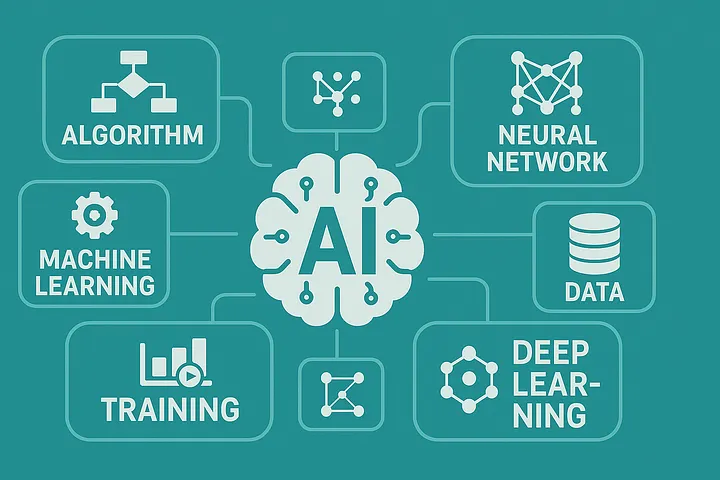
To truly understand and utilize AI, we must first understand the key terminologies and foundational concepts behind it. These concepts — such as machine learning, deep learning, and neural networks — explain how machines mimic human intelligence and make decisions in real-time.
This article serves as a detailed yet beginner-friendly guide, perfect for learners, students, developers, and professionals stepping into AI.
What Is Artificial Intelligence (AI)?
Artificial Intelligence (AI) is a branch of computer science that develops systems capable of performing tasks that normally require human intelligence.
These tasks include:
- Problem-solving
- Learning from experience
- Understanding language
- Recognizing patterns
- Reasoning and decision-making
- Perception (vision, speech, etc.)
- Creativity
- Planning and adapting to new information
Definition (Easy to Remember):
AI is the science of creating machines that can think, learn, and act like humans.
Types of Artificial Intelligence
AI is categorized into three major types based on capability and intelligence level.
1. Narrow AI (Weak AI)
Narrow AI is designed to perform one specific task.
It does not understand the world beyond its programmed function.
Examples:
- Google Search
- Face recognition in smartphones
- Chatbots
- Spam filters
- Recommendation systems (Netflix, Amazon, YouTube)
2. General AI (Strong AI)
General AI possesses human-like cognitive abilities — it can learn, understand, and perform any intellectual task like a human.
This type of AI remains theoretical and has not yet been achieved.
Capabilities expected:
- Autonomous decision-making
- Adaptive learning
- Reasoning across multiple domains
3. Super AI (Artificial Superintelligence)
Super AI surpasses human intelligence.
🚨 Note: Super AI is purely conceptual and often discussed in futuristic scenarios.
Machine Learning (ML): The Engine Behind AI
Machine Learning is a subset of AI that enables machines to learn from data without explicit programming.
Machine Learning uses algorithms to analyze data, identify patterns, and make intelligent decisions.
⭐ Key Characteristics of Machine Learning
- Learns from large datasets
- Improves performance over time
- Does not rely on hard-coded rules
- Makes predictions based on learned patterns
- Enables automation of decision-making
Example of Machine Learning
Imagine a spam detection system:
- You provide thousands of examples of spam and non-spam emails.
- The ML model learns patterns such as suspicious words, links, and formatting.
- When a new email arrives, it predicts whether it is spam — without being explicitly programmed.
🧠 Deep Learning (DL): Advanced Machine Learning
Deep Learning is a specialized subset of machine learning that uses multi-layered neural networks (deep neural networks).
Definition:
Deep Learning uses interconnected neural networks to analyze large volumes of complex data and make highly accurate decisions.
It is inspired by the functioning of the human brain.
⭐ Key Features of Deep Learning
- Works with unstructured data (images, videos, audio, text)
- Automatically extracts and learns features
- Requires huge datasets
- Improves accuracy with every training cycle
Example of Deep Learning
- Image recognition (identify humans, objects, animals)
- Voice assistants like Alexa, Siri, and Google Assistant
- Automatic video captioning
- Self-driving cars detect lanes, pedestrians, and obstacles
🧩 Neural Networks: The Brain Behind Deep Learning
Neural networks are computational models inspired by the neuron structure of the human brain.
Definition:
A neural network is a collection of interconnected nodes (neurons) that process input data and generate meaningful outputs.
🔗 Structure of a Neural Network
A typical neural network has three major layers:
1. Input Layer
- Receives raw data
- Example: Pixels of an image, text input, numbers
2. Hidden Layers
- Perform complex computations
- Identify patterns
- Deep learning networks may have 10–100+ hidden layers
3. Output Layer
- Produces results
- Example: “Dog detected”, “Spam email”, “Approve loan”, “Translate text”
🔍 Example:
In face recognition:
- The input layer receives an image
- Hidden layers analyze features (eyes, nose, shape)
- The output layer identifies the person
Real-World Application Example: Autonomous Vehicles
Self-driving cars rely heavily on the terminology discussed:
- Machine Learning → learns driving patterns
- Deep Learning → identifies roads, signs, objects
- Neural Networks → make driving decisions
- AI → navigates, predicts motion, and ensures safety
Understanding these AI concepts helps us appreciate how such systems operate safely at high speeds and in unpredictable environments.
Why Understanding AI Terminologies Is Important
Knowing these terms gives professionals an edge in:
- Innovation
- Problem-solving
- Research and development
- AI implementation
- Business transformation
It also enhances your ability to:
- Build intelligent applications
- Understand technological trends
- Collaborate with teams in tech industries
Summary of Key Terms
- Artificial Intelligence: Machines that simulate human intelligence
- Narrow AI: Designed for one task
- General AI: Human-like abilities across tasks
- Super AI: Beyond human capabilities
- Machine Learning: Learning from data without rules
- Deep Learning: Multi-layered neural networks analyzing large data
- Neural Networks: Brain-inspired models with neurons and layers
Conclusion
Artificial Intelligence is not just a technology — it is a transformative force shaping the future of industries, communication, education, transportation, healthcare, and business.
Understanding key terminologies such as AI types, machine learning, deep learning, and neural networks builds a strong foundation for anyone entering the world of AI. As technology evolves, these concepts will continue to drive innovation and create opportunities across various domains.
Whether you’re a student, developer, business professional, or tech enthusiast, mastering these terminologies unlocks the ability to harness AI’s full potential and stay relevant in a rapidly advancing digital world.
Comments
Post a Comment